
Letter to Asheville City Council in Support of Zoning Text Amendments
August 19, 2026
Asheville For All sent the following letter to Asheville City Council ahead of the council’s August 25th meeting.
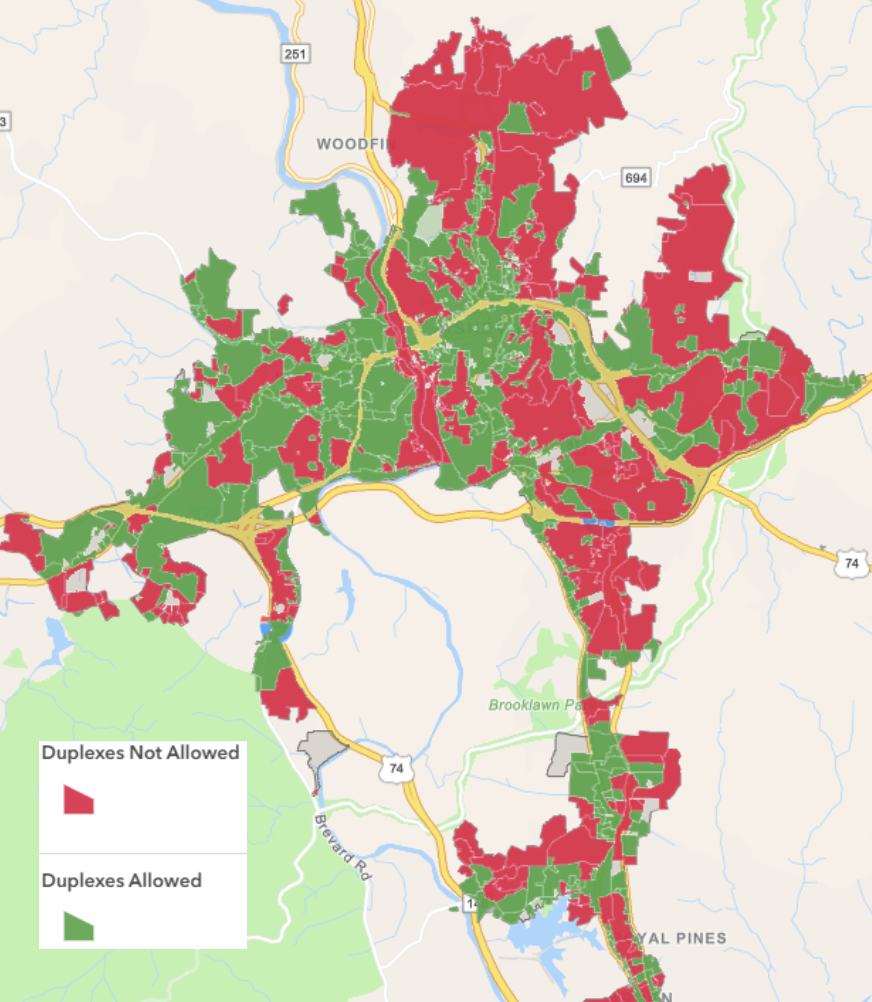
Council will be considering zoning text amendments—changes to city’s land use rules—that will a) allow duplexes to be built in residential neighborhoods across the city, and b) gently increase the allowable size of accessory dwelling units (ADUs).
* * *
Dear Asheville City Council,
Unsurprisingly, we are writing to you in favor of the zoning text amendments on the council agenda for August 25th.
We just want to share two points ahead of Tuesday:
1. We Should Celebrate!
First, we think it’s important to note that the tone for these kinds of hearings sometimes feels unnecessarily dour. While we believe that these zoning text amendments are small in ambition compared to the scale of the city’s housing shortage, at the same time we should celebrate the end of single-family-ONLY-zoning!
In fact, Buncombe County had such a celebration last year. As Amanda Edwards noted, it was a “big moment” when the county eliminated its single-family-ONLY zoning.
There is no debate that exclusionary zoning is a tool born of racism, xenophobia, anti-Semitism, and classism, and that it promotes high housing costs, limits mobility, and fosters homelessness for ALL kinds of working people and families. We say good riddance!
2. The City’s Own Studies Discount the Importance of “Sequencing”
The matter of “sequencing” arose at this month’s Planning and Zoning Commission meeting. The argument against passing the zoning text amendments is that they should only be considered after certain “anti-displacement” provisions are put in place.
In certain cases, it’s quite likely that proper sequencing for the implementation of public policy matters. This is not such a case.
Asheville’s 2023 Missing Middle Housing Study and Displacement Risk Assessment and 2024 Affordable Housing Plan both cite broadly applied zoning reforms as anti-displacement programs themselves.
Further, the 2024 Affordable Housing Plan includes an Implementation Roadmap timeline in its appendix, which suggests that modest residential zoning reforms be given the highest priority, even relative to other anti-displacement strategies.
Cities from Minneapolis, MN to Portland, Oregon to Zurich, Switzerland have shown that broadly applied residential zoning reforms do not cause land-value shocks, speculation, gentrification, or displacement risk, but rather that over time, they slow or reverse increases in rent and home prices, and provide residents greater and more affordable housing options.
The language of sequencing, though well meaning, pits anti-displacement strategies against one another. Alternatively, we believe that it’s clear that various programs and code reforms are additive. The more the city can do, and the quicker we can do it, the better off our residents will be, and the better positioned we’ll be to welcome new neighbors.
And the more we’ll have to celebrate!
Thank you as always for your consideration and for all that you do.
Asheville For All Lead Organizers